For more than two years, a softball-sized golden lump pulled from the lightless depths of the Pacific had marine biologists scratching their heads. After a patient detective story involving microscopes, DNA sequencing, and a stroke of luck from a 2021 sample, scientists know exactly what they were looking at, and the answer is wonderfully strange.
- The orb was found in 2023 about 2 miles below the surface of the Gulf of Alaska
- It turned out to be the cuticle base of a giant deep-sea anemone, Relicanthus daphneae
- The species can grow tentacles up to 7 feet long and is rarely seen by humans
A Strange Find on a Rocky Outcrop
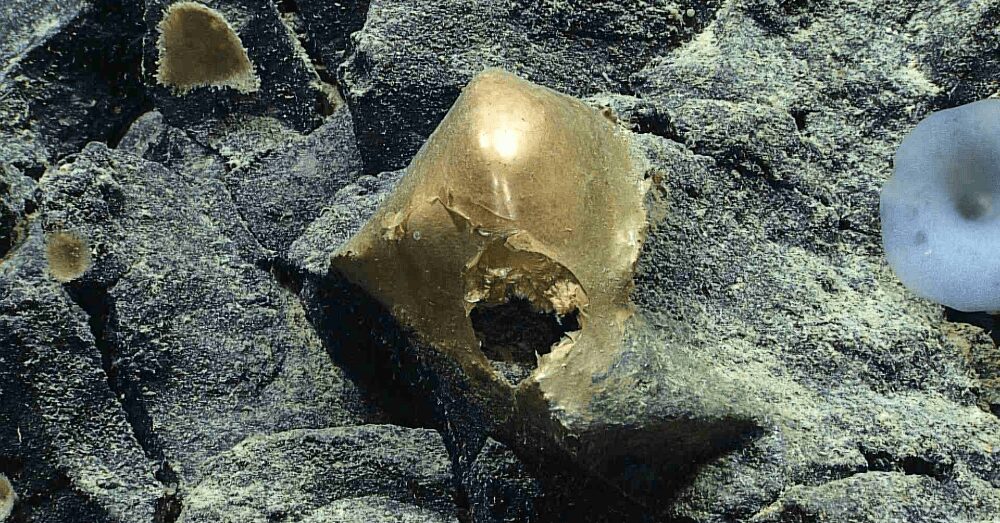
The story starts on August 30, 2023, during NOAA’s Seascape Alaska 5 expedition. The remotely operated vehicle Deep Discoverer, launched from the Okeanos Explorer, was working more than 2 miles below the surface in the Gulf of Alaska when it spotted something unusual. A rounded, golden object with a small opening sat on a rock, looking like nothing the team had seen before.
About 4 inches across, the mysterious object turned up among small glass sponges on the seafloor southwest of Walker Seamount. The shiny blob was so unfamiliar that the live-stream audience and the science team alike started tossing out wild guesses. Was it an egg case? A dead sponge? Something that had crawled in or out? Pilots used a suction sampler to bring it back to the ship for closer study.
Why It Took So Long to Crack
The orb went to the Smithsonian National Museum of Natural History, where researchers expected a quick answer. It didn’t come. The team found that it didn’t have animal anatomy, just a fibrous material covered with stinging cells called spirocysts, a specialized cellular structure that can capture prey. Such cells only exist in one group of aquatic invertebrates, the cnidarians.
That clue narrowed the suspects to roughly 4,000 species in the Hexacorallia class, but DNA work hit a wall. Initial DNA barcoding was inconclusive, likely because the sample picked up DNA from other microscopic life. Whole-genome sequencing then confirmed animal DNA and contained a large amount of genetic material from a giant deep-sea anemone, with mitochondrial genomes nearly identical to a known Relicanthus daphneae reference.
The breakthrough also leaned on human expertise. EstefanÃa RodrÃguez, curator of marine invertebrates at the American Museum of Natural History in New York, who had studied R. daphneae specimens for years, recognized the tissue as a cuticle, the structure an anemone secretes beneath itself to cement to rock.
Meet Relicanthus daphneae
The animal that left this calling card is itself a deep-sea oddity. The species was discovered in the 1970s but wasn’t formally classified until 2006. These anemones live on the ocean floor, usually near thermal vents, with pinkish or pale purple tentacles that stretch as long as seven feet. Its stinging spirocysts are the largest among all known cnidarians.
The cuticle’s main ingredient appears to be chitin, the same tough, fibrous material that makes up beetle cases and fungal cell walls. Think of it as a biological glue pad that the anemone leaves behind when it’s done with a spot.
An Anemone That Can Pack Up and Move
So why was the base sitting there alone, with no anemone on top? Researchers think R. daphneae secretes a cuticle to attach to rock but can detach to move to a better location and create a new one. In some videos, scientists can see cuticle on the rock next to a living anemone, and in one case there’s a long trail along a rock where the animal appears to have repeatedly relocated.
There’s another possibility too. One interpretation is that the orb is a remnant of incomplete asexual reproduction. Some sea anemones are capable of pedal laceration, in which the base of the polyp is abandoned and the upper portion moves away, leaving a stump that regrows into a new polyp.
The leftover blob isn’t just a curiosity either. The sheer volume of microorganisms found on the cuticle suggests it may act as a microscale hotspot of microbial activity, where microbes feed on and break down the decaying tissue, contributing to the nitrogen cycle.
Secrets Still Stuck to the Seafloor
This case shows how much remains unknown miles below the surface. Collected specimens of R. daphneae rarely have a cuticle, and this ability to leave it behind might explain why. The abandoned cuticle could also offer a clue to how the animal reproduces, a process that’s tough to study in such an inaccessible habitat. If a 4-inch golden blob can stump some of the world’s best marine biologists for two and a half years, it’s a fair bet the seafloor has plenty more secrets stuck to its rocks, just waiting for an ROV’s lights to find them.