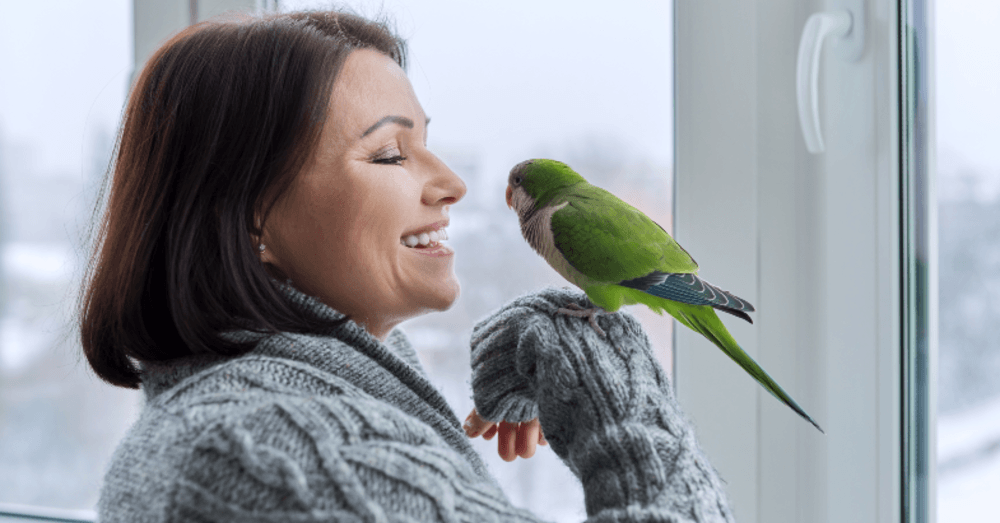
Your parrot might not just be parroting. A sweeping new study of nearly 900 companion birds suggests that many pet parrots use human words as genuine proper names, assigning specific sounds to specific individuals the same way people do, while also inventing a few quirky uses all their own.
- Researchers analyzed vocalizations from more than 880 captive parrots across dozens of species.
- 88 birds from 30 species used names accurately for specific people or animals, with 42 reserving a name for a single individual only.
- Some parrots shouted their own name for attention or called out absent flockmates by name.
A Clever Workaround to a Classic Research Problem
Studying animal language in the wild is notoriously tricky. Calls are complicated, and humans rarely know what the animals actually mean. So Lauryn Benedict, a biology professor at the University of Northern Colorado, didn’t set up shop in the tropics to record parrot chatter. She found birds who already spoke her language instead, birds that live with humans and mimic what they hear, including people’s names.
Working with collaborators from the University of Vienna, the Acoustics Research Institute at the Austrian Academy of Sciences, and the University of Pittsburgh at Johnstown, the team looked for evidence that some birds don’t just mimic speech but actually assign and use names to identify specific individuals. Their findings were published in April 2026 in the journal PLOS One.
What the Numbers Actually Show
The team used an online survey called “What Does Polly Say?” to collect reports from parrot owners around the world. Forty-seven percent of reports on 884 birds included examples of name use, with those 413 parrots speaking 802 phrases that included names.
From there, researchers looked for stricter patterns of true naming. A total of 88 birds from 30 species showed appropriate use of names, meaning they used names correctly for specific individuals. Out of these, 42 birds from 19 species showed individualized use. They used names only for one specific individual, not for a group.
Of all the species surveyed, grey parrots showed the strongest tendencies toward correct name use, which tracks with decades of earlier work on the famously clever African greys.
Greetings, Goodnights, and Calling Out the Missing
The researchers sorted phrases by social context and found the patterns you’d expect from a social tool. The team classified every phrase into contexts such as greeting, separation, attention-seeking, and request. The results lined up with the idea that names are tools for managing social life. Parrots used names to say hello, to mark goodbyes at bedtime, and to get their humans to look up from the couch.
Some examples are genuinely charming. One bird said “goodnight [name]” to each flockmate as they went to bed. At least ten birds asked for a person by name only when that person was not present. This suggests they may understand that individuals still exist even when they cannot be seen. That’s a cognitive leap that goes well beyond copying sounds.
There were also moments that don’t match human habits at all. Many of the birds used these labels in ways people typically wouldn’t. For instance, parrots sometimes said their own name just so they could get some attention. Picture a toddler yelling their own name across a room, except with feathers.
Why Parrots (and Not Place Names) Learn What They Learn
One quirk in the data says a lot about how these birds pick up vocabulary. No parrots were reported to use place names. The researchers think this reflects how humans speak around them. People repeat a bird’s name often, but rarely use place names in daily interaction with them.
Parrots mostly learn whatever we say most often around them. A bird living in a quiet home might learn three names, while a bird perched in a chatty environment like a family kitchen or even the waiting area of a busy Ford dealership could pick up a rotating cast of employees, customers, and pets. The vocabulary reflects the social world the bird is embedded in.
So, Can Parrots Really Talk About Us?
The authors are careful not to overclaim. “We cannot conclude that they are analogous to human names both because animal signals are often so different and because we don’t understand the full intent behind the signals,” co-author Christine Dahlin noted. Still, the pattern is hard to ignore.
This research suggested that parrots do have the cognitive and vocal skills to use names in different ways, from communicating with people to even talking about someone who isn’t there. The variation across species and even across individuals of the same species, though, leaves room for plenty of questions about how, when, and why animals do or don’t use these skills to call out another creature by name.
A Smarter Bird Than You Thought
The next time your bird greets you by name, it might actually mean you, specifically. And if it starts yelling its own name from the living room? That’s just Polly asking for a snack.